

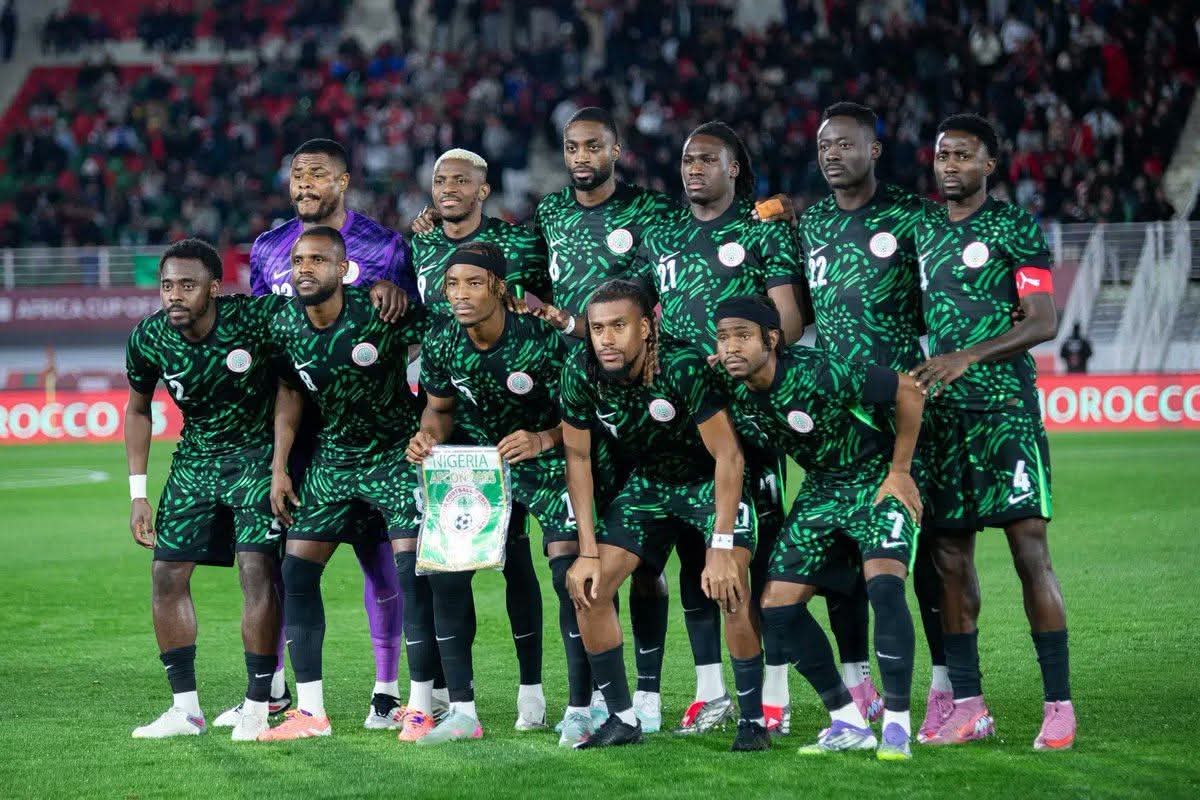
Nigeria can select forwards with very different reputations, physical qualities and club backgrounds. Victor Osimhen attacks space and the penalty area, Ademola Lookman can create or finish from the left, Victor Boniface combines strength with ball-carrying, Paul Onuachu offers height inside the box, while Samuel Chukwueze provides one-on-one ability from wide positions. On paper, that should give the Super Eagles an answer to almost every defensive problem. In practice, fitting those qualities into one functioning attack has often been more difficult than the list of names suggests.
The strongest evidence that this is a structural issue, rather than a shortage of talent, came at AFCON 2025. OwnGoalNigeria highlighted how Eric Chelle’s diamond formation brought more out of Iwobi and several of his teammates. At the same tournament, CAF’s official group-stage figures showed Nigeria leading the competition with eight goals and an average of 66% possession. The players had not suddenly become more talented. Their roles simply fitted together more effectively.
That distinction cannot be captured fully by football teams ranking, which can compare results, form and relative strength but cannot show whether a squad contains the right balance of creators, carriers, runners and finishers. Nigeria’s attacking depth is real. The more important question is whether the strongest individuals can provide all the functions required by the same system.
Nigeria’s Greatest Depth Comes at the End of Attacks
Many of Nigeria’s best-known attacking players are most dangerous after the ball has already been moved into an advanced position.
Osimhen can stretch a defence with his running, attack crosses and turn imperfect deliveries into scoring opportunities. Lookman is effective when he receives in space, moves inside from the flank or combines around the penalty area. Onuachu offers a clear target for crosses, while Chukwueze is at his best when isolated against a defender and allowed to attack him directly.
Those qualities are valuable, but they largely belong to the final stages of an attack. Before any of them can influence a match, someone must carry or pass the ball through midfield, attract pressure, connect the lines and create the situation in which the forwards can attack.
This is where the apparent depth of the squad can become misleading. Replacing one striker with another may change the type of finishing available, but it does not necessarily improve the team’s ability to reach the striker. Adding another winger may increase pace or dribbling without solving the problem of progressing the ball through a compact midfield.
Nigeria can therefore have several strong alternatives for the same phase of play while remaining short of specialists in another.
Why Iwobi So Often Becomes the Solution and the Sacrifice
Alex Iwobi’s changing role for the Super Eagles illustrates the problem.
Closer to goal, he can combine with forwards, find passes between defenders and arrive around the penalty area. Deeper in midfield, however, he is also one of the players most capable of receiving under pressure and moving possession from the first phase of the attack into the next one.
If Nigeria lack another reliable connector in midfield, a coach has to decide where Iwobi is needed most. Moving him deeper can improve progression but reduce his influence near the opposition box. Pushing him forward may increase creativity in attacking areas while leaving the team with a more difficult route out of defence.
That is not simply a case of one coach choosing the wrong position. Different Super Eagles managers can reach similar decisions because they are responding to the same imbalance in the available profiles. Iwobi becomes the compromise: the player used to repair one part of the structure even when doing so removes something from another.
More Forwards Do Not Always Create More Chances
The temptation when a team is struggling to score is to select another attacker. For Nigeria, that can mean using two central forwards, moving a winger into a narrow role or placing several direct players behind Osimhen.
Such changes increase the number of potential finishers, but they can also reduce the number of players involved in constructing attacks.
Two strikers may occupy both central defenders, yet the team can lose control of midfield. Narrow attackers may bring players closer to goal, but they can also leave the full-backs responsible for almost all the width. A highly direct front line can be dangerous during transitions while struggling against opponents who defend deep and offer little space behind them.
The issue is not whether Nigeria should play one striker or two. It is whether the players behind them can consistently create the conditions that make either arrangement work.
This is why the Super Eagles can look devastating in an open match and much less convincing against a compact defensive block. Space allows the attackers to use pace, movement and individual ability. A settled defence demands more patient circulation, positional discipline and repeated combinations between midfielders, full-backs and forwards.
Club Form Depends on Relationships, Not Only the Player
The phrase “club form” can make performance sound like a possession belonging entirely to the individual. In reality, a player’s form is partly produced by his surroundings.
At club level, a forward works for months with teammates who understand his movement. He knows which midfielder will attempt an early pass, when the full-back is likely to cross and where the winger will move when he leaves the centre. These patterns become reliable because they are repeated throughout the season.
International teams cannot reproduce that level of preparation for every player. An Opta Analyst study of club and international football found that the club sides in its sample averaged 44.3 matches per season, compared with 11.2 for the international teams. Nigeria must use its limited camps to combine players arriving from different leagues, formations and tactical environments.
The coach cannot recreate Osimhen’s club system, Lookman’s club system and the preferred conditions of every other attacker at the same time. A collective model has to be chosen, which inevitably means that some players will operate without all the support structures that contribute to their club performances.
Why a New Coach Cannot Solve Everything Immediately
Changing the coach can improve the structure, but it cannot alter the distribution of qualities in the squad.
One manager may protect the midfield by using an additional defensive player. Another may adopt a diamond to create more central passing options. A third may favour wingers and transitions. Each approach can release certain players while restricting others.
The diamond used at AFCON 2025 was effective because its parts complemented one another. The midfield gained clearer connections, Iwobi could influence progression without carrying the entire creative burden, and the full-backs supplied width around a narrow attacking structure. Nigeria’s improved output showed what can happen when roles are organised around the actual characteristics of the squad.
It did not mean that one formation had permanently solved every attacking problem. Personnel, opponent and match situation still matter. What it demonstrated was that the gap between club and international performance is not always explained by commitment, confidence or individual quality. Sometimes it is the difference between being placed inside a complete mechanism and being asked to compensate for the mechanism’s missing parts.
The Real Challenge Is Functional Balance
Nigeria’s attacking strength should not be measured only by how many recognised forwards are available. It should also be measured by how easily those forwards can be connected to midfield, supplied in their preferred areas and combined without weakening the rest of the team.
The Super Eagles do not lack attacking talent. Their recurring challenge is that much of that talent is concentrated among players who are most dangerous near the completion of moves. The team must still provide the progression, width, creativity and control that allow those moves to develop.
When those functions are balanced, as they were during strong periods at AFCON 2025, Nigeria can look like one of Africa’s most complete attacking sides. When they are not, adding another celebrated forward may improve the team sheet without improving the attack.

