

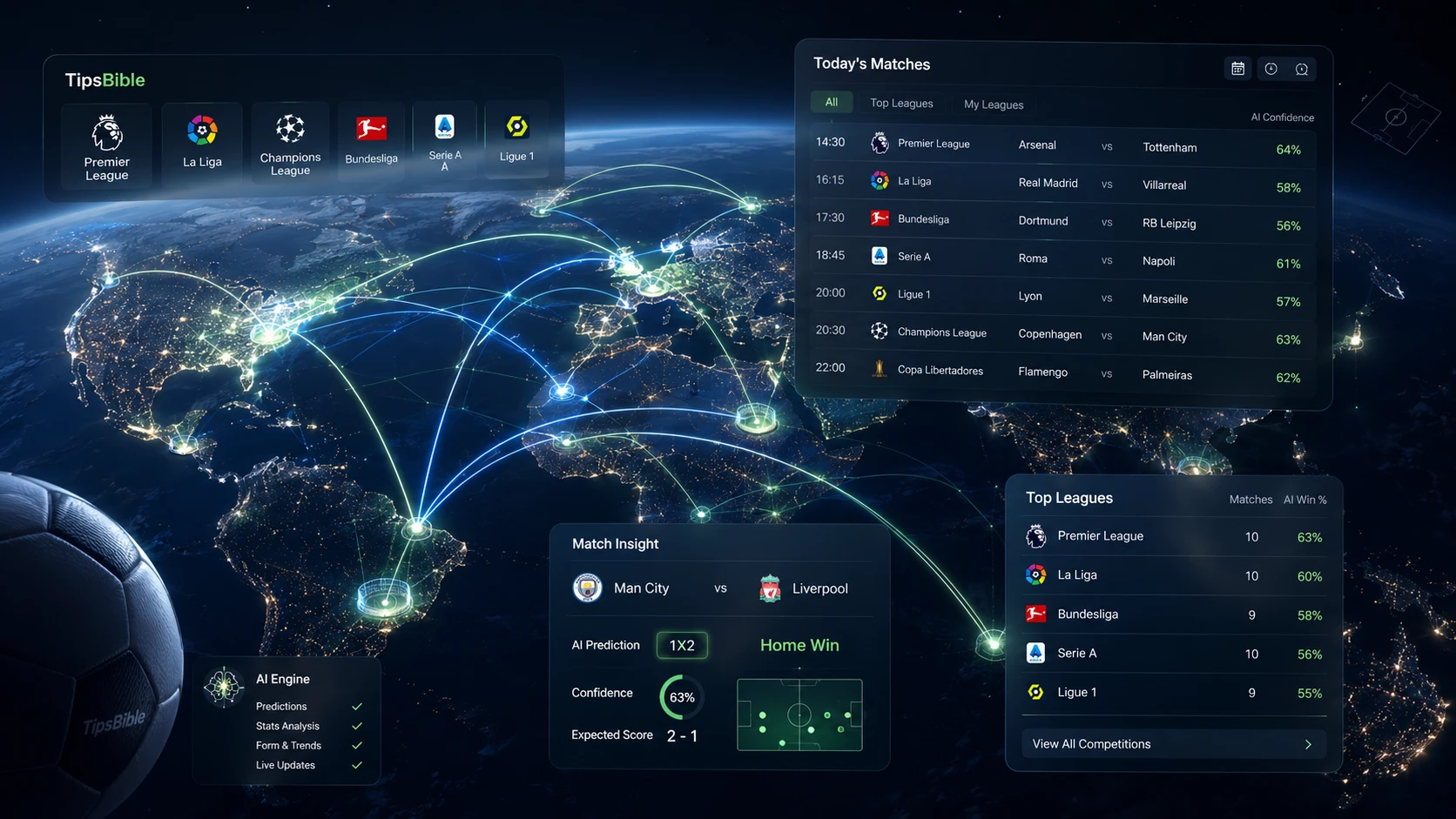
A modern football day no longer begins with one league and ends with another. Matches overlap across countries, time zones and competitions. A supporter may start the morning with an early fixture in Asia, move through European leagues during the afternoon and finish with games from North or South America late at night.
The variety is part of football’s appeal, but it also creates a practical problem. The larger the schedule becomes, the harder it is to understand what is actually worth following. Fixtures are scattered across league pages, live-score applications, club accounts and news feeds. Important context can disappear between kickoff times, odds tables and last-minute updates.
A useful prediction platform therefore has to do more than publish isolated tips. It must organise the day.
That is the central idea behind a service that places fixtures, markets, confidence ratings and results in one connected view. Instead of forcing users to search match by match, the platform turns a crowded football calendar into a schedule that can be scanned, compared and understood.
Matchday has become an information problem
For most of football history, following the day’s programme was relatively simple. Supporters focused on a domestic league, a local club or a small number of televised matches. Today, access is global. A second-division fixture can attract interest from another continent, while a cup tie in a smaller football nation may appear beside major European games on the same screen.
More access does not automatically create more clarity.
A long fixture list can become difficult to navigate when every match is presented with equal visual weight. The user may see dozens of kickoffs but receive little help in distinguishing between a high-confidence prediction, a balanced game and a fixture with limited information.
This is why organisation matters. A strong platform should help answer three basic questions quickly:
What is being played today? What type of prediction is available? How strongly does the available data support it?
The goal is not to make every match look important. It is to make the schedule usable.
One daily view reduces unnecessary searching
The most obvious advantage of bringing the full schedule together is convenience, but the effect goes beyond saving a few clicks.
When fixtures appear in one daily view, users can compare them before becoming attached to a particular selection. They can move between leagues, kickoff times and markets without opening several websites or attempting to remember which game was listed where.
A central schedule also makes the shape of the day visible. Busy periods become clear. Early fixtures can be separated from evening matches, and users can see whether several competitions are running at the same time.
This matters because football analysis is often distorted by familiarity. People naturally focus on famous teams, televised leagues or clubs they already follow. A well-organised schedule can reveal that the most interesting statistical profile may belong to a less publicised fixture.
The platform is not choosing a favourite club for the user. It is providing a wider field of comparison.
Coverage should extend beyond headline leagues
Major competitions deserve attention, but they represent only part of the daily football calendar.
A schedule built only around the Premier League, La Liga, Serie A, Bundesliga and Ligue 1 will look useful on a busy European weekend. It becomes far less complete during international breaks, summer months or midweek periods dominated by cups and smaller domestic competitions.
Broader coverage gives a platform continuity. There is usually football somewhere, even when the largest leagues are quiet.
TipsBible states that it currently covers 48 leagues and provides daily predictions across major leagues and cup competitions. Its league pages also bring together upcoming tips, confidence ratings, tables, recent results and season trends, allowing users to move from the overall schedule into the context of a specific competition.
The value of that structure is not that every league is equally predictable. They are not. The value is that users can see a wider range of fixtures without losing the competition-level information needed to interpret them.
A schedule becomes more useful when markets are organised too
Listing matches is only the first layer. The next challenge is presenting the available prediction markets clearly.
A single fixture can produce several different questions. Who is more likely to win? Will both teams score? Is the total likely to finish above or below a goal line? Is a double-chance position more suitable than a straight result? Does the projected game pattern support a bet-builder combination?
If all of these markets are presented without hierarchy, the page can become harder to use than the fixture list it replaced.
A cleaner approach is to give each match a primary prediction while keeping additional markets available for users who want more detail. This creates a natural path: scan the day, open the fixture and then examine the supporting options.
The TipsBible homepage lists match result, double chance, over/under goals, both teams to score, correct score, half-time/full-time and bet-builder selections among the markets it covers. Each prediction is paired with a confidence score intended to show how strongly the model supports the call.
That confidence number does not turn an uncertain match into a certainty. Its practical role is comparative. It helps users distinguish between a marginal lean and a selection supported by a stronger alignment of signals.
The daily schedule should not end at kickoff
Many football pages are useful before a match and almost empty afterwards. Once kickoff arrives, the prediction disappears from attention and the platform moves on to the next fixture.
That breaks the connection between forecast and outcome.
A properly organised schedule should continue through the full life of the prediction: publication, kickoff, final whistle and settlement. The result belongs beside the original call because users need to know not only what was predicted, but what happened.
This also makes the daily page more useful over time. Yesterday’s schedule becomes a record. A league page becomes more than a list of upcoming matches. A team page begins to show how different markets have performed across several fixtures.
TipsBible says its predictions are generated automatically, locked before kickoff and graded publicly after matches, with wins and losses retained in the record.
For users, that creates continuity. The schedule does not vanish when the games finish; it becomes evidence that can be reviewed.
Why team and league pages matter
A global fixture list is useful for discovery, but users eventually need context.
Suppose a match from an unfamiliar competition appears with a high confidence rating. A bare prediction is not enough. The reader may want to see the league table, recent scoring levels, home and away patterns or how often both teams have scored during the season.
This is where dedicated league and team pages become important. They allow the platform to remain broad at the top level while becoming specific when a user opens a fixture.
The difference is similar to using a map. The daily schedule shows the entire area; the league and team pages provide the street-level detail.
This structure can also reduce impulsive decisions. Instead of treating the confidence number as a final answer, the user has a route into supporting information. A prediction becomes the beginning of the analysis rather than the end.
Artificial intelligence is most useful at scale
The strongest argument for AI in football forecasting is not that it can remove uncertainty. It cannot. Its advantage is the ability to process a large number of fixtures through a consistent method.
A human analyst can study a small group of matches in depth, but covering a global schedule every day creates a different challenge. Data must be collected, compared and refreshed across leagues that may have different styles, calendars and levels of available information.
An automated model can evaluate recurring factors without becoming tired or skipping a fixture because it is less famous. TipsBible describes its system as using signals such as form, expected goals, home and away splits, injuries, lineups and head-to-head information, with predictions produced automatically rather than manually selected.
Consistency is important here. If the model evaluates the same categories across the schedule, users can compare outputs more meaningfully. The platform is not claiming that every league behaves identically. It is applying a stable process to a varied football calendar.
Free access gives the schedule a practical entry point
A large prediction platform can look overwhelming to a new visitor. Even a well-organised interface contains unfamiliar leagues, markets and percentages.
A free daily selection provides a simple place to begin.
Instead of exploring the entire schedule immediately, the user can inspect one highlighted prediction, see how it is displayed and follow it through to the final result. From there, the broader fixture list becomes easier to understand.
TipsBible says fresh football tips are available daily and that a free account can unlock upcoming predictions, full odds, value ratings and a daily accumulator.
This type of access works best when it is treated as a demonstration rather than a promise. One selection cannot prove long-term performance. It can show whether the platform is clear, timely and consistent.
Tomorrow’s matches are part of today’s planning
Football users do not always arrive shortly before kickoff. Many want to look ahead.
A schedule that separates today’s predictions from tomorrow’s fixtures allows people to plan without mixing two different matchdays. It also gives time for team news, market movement and lineup information to develop.
This distinction is especially useful during busy periods. European competitions may dominate one evening, domestic leagues the next, followed by cup football at the weekend. A combined undated feed would quickly become confusing.
Clear day-based navigation creates rhythm. Today is for the active slate; tomorrow is for preparation.
It also helps prevent old information from remaining prominent after the schedule has moved on. Football changes quickly, and the page should make the timing of every prediction obvious.
Mobile organisation matters on busy matchdays
The need for a central schedule becomes even stronger on a phone.
Desktop users can open several tabs and compare information side by side. Mobile users usually move through one narrow screen, often while travelling, watching a match or checking fixtures between other tasks.
A long list without filters becomes exhausting. The most useful mobile experience prioritises kickoff time, league, prediction, confidence and match status. Additional statistics can remain available after the user opens the fixture.
The principle is simple: show enough information to support the next decision, but not so much that the schedule becomes unreadable.
Good organisation is not about adding features. It is about deciding which information deserves to appear first.
A complete schedule still requires selective attention
Bringing every fixture into one place does not mean users should act on every match.
In fact, a complete schedule should make selectivity easier.
When people can compare leagues and confidence levels, they are less dependent on the first prediction they happen to encounter. They can ignore low-information fixtures, avoid forcing interest in quiet days and focus on the games that genuinely deserve attention.
This is an important distinction. Coverage is about availability; decision-making is about restraint.
A platform can analyse a large number of matches while the user chooses only a small number to follow. The system handles the scale so the reader does not have to.
The football calendar needs a clearer front door
The modern football schedule is not short of information. It is short of structure.
Scores, odds, statistics and predictions are widely available, but they are often separated across pages that do not communicate with one another. The result is a fragmented matchday experience in which users spend more time searching and less time understanding.
A central platform can solve part of that problem by connecting the daily fixture list with prediction markets, confidence ratings, league context and settled results.
The most valuable feature is not simply the number of matches covered. It is the way those matches are arranged into a journey: discover the fixture, inspect the prediction, open the context and return later to see the result.
When that process works, a crowded global schedule becomes manageable. The platform does not make football simpler than it really is. It makes the information around football easier to use.