

There is a curious contradiction at the heart of football. Some of the greatest players the game has produced have discovered, after retirement, that brilliance on the pitch is no guarantee of brilliance from the dugout.
The qualities that make a player exceptional, instinct, technique, athleticism, imagination and the ability to solve problems in an instant, are not necessarily the qualities required to manage a squad of 25 players, construct a tactical system, negotiate personalities and persuade an entire team to see the game through one set of principles.
Pep Guardiola is one of the most compelling exceptions to that rule. He was a highly accomplished footballer, but he was not a global superstar in the mould of Lionel Messi, Diego Maradona or Ronaldo. His reputation as a player was built largely around intelligence, positioning and his ability to organise the game from midfield. Yet as a manager, he has reached a level that very few former players have matched.
The numbers tell only part of the story. Guardiola’s first-team Barcelona side won 14 trophies in four seasons between 2008 and 2012, including three La Liga titles and two Champions Leagues. His first season produced the club’s first-ever treble of La Liga, the Copa del Rey and the Champions League. In 2009, Barcelona then became the first team to win all six major competitions available to them in a calendar year.
His success did not stop when he left Spain. At Bayern Munich, Guardiola won the Bundesliga in each of his three seasons, becoming the first coach to win the German championship in each of his first three campaigns. He subsequently moved to Manchester City, where he transformed the club into the dominant force in English football. City won the Premier League in 2017/18 with a then-record 100 points, retained the title the following season and eventually became the first English men’s team to win four consecutive top-flight championships in 2023/24.
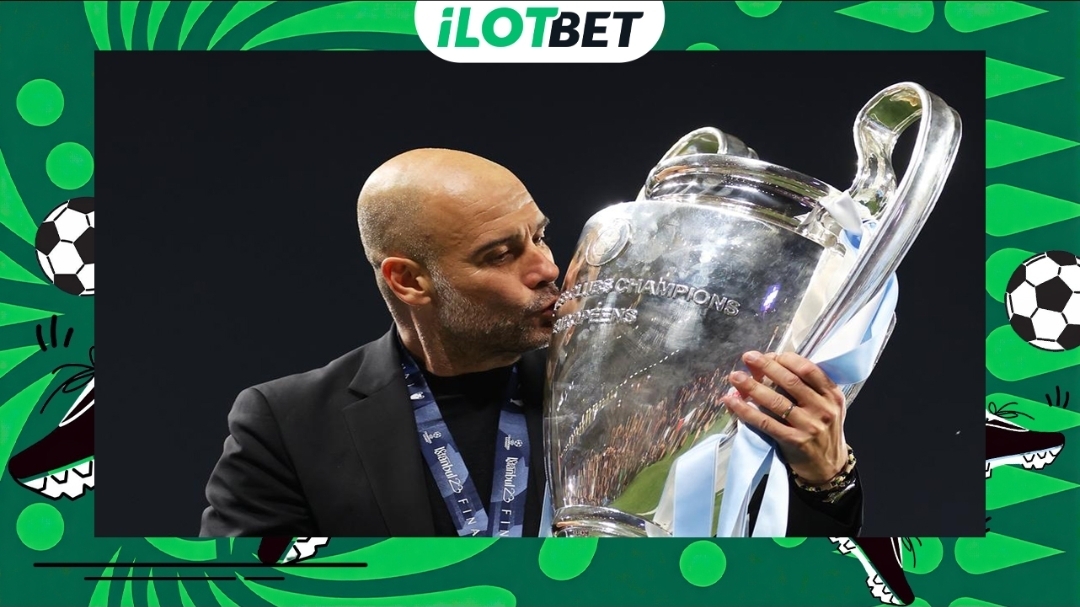
By 2023, Guardiola had also completed perhaps the most significant missing piece in his managerial CV. Manchester City’s Champions League victory over Inter Milan gave him a second European treble, following the one he achieved with Barcelona in 2008/09. He consequently became the first manager to win the European treble with two different clubs.
But Guardiola’s achievement becomes more interesting when viewed against his playing career. He was not simply a retired footballer who happened to become a successful coach. Long before he became one of football’s most influential managers, he had spent years learning a particular way of understanding the game.
At Barcelona, Guardiola played under Johan Cruyff during the club’s famous Dream Team era. He was the team’s midfield organiser, operating at the base of the midfield and helping to dictate the rhythm of matches. Barcelona describe Cruyff as having considered Guardiola an “extension of himself” on the pitch. Guardiola himself has repeatedly credited Cruyff as the most important influence on his football education, describing training under him as being like going to university every day.
That education matters because Cruyff did not merely teach Guardiola where to stand. He taught him to think about football as a system of relationships.
Possession was not simply about keeping the ball. Positioning was not simply about occupying space. Passing was not merely about finding a teammate. Every movement was intended to alter the opponent’s structure and create the next available solution.
Guardiola absorbed that philosophy as a player and eventually turned it into a coaching methodology. When he became Barcelona B manager in 2007, he was not thrown immediately into the pressure cooker of elite management. He spent a season working with young players and guiding the reserve team to promotion. Barcelona subsequently promoted him to the first team in 2008.
That pathway may be one of the most important differences between Guardiola and the stereotype of the superstar footballer who retires and immediately receives a major managerial job.
Guardiola had to coach before he became a celebrity coach.
He had to explain ideas to young players. He had to plan training sessions. He had to deal with players who did not automatically understand his intentions. He had to experiment, make mistakes and discover how to translate his own understanding of football into instructions that other people could execute.
That distinction is crucial. A brilliant footballer can see a pass that nobody else sees. A brilliant manager has to make eleven players understand why that pass becomes possible in the first place.
Guardiola’s Barcelona appointment also gave him another advantage, he inherited a football culture he understood intimately. He knew the club, its academy and its expectations. More importantly, he understood the footballing language that had been established before him.
But Guardiola did not simply reproduce Barcelona’s football. He evolved it.
Barcelona’s official history notes that he initially used the 4-3-3 system familiar from his work with the reserves but also demonstrated tactical adaptability, including experiments with a more attacking 3-4-3.
That adaptability became one of the defining characteristics of his career.
It is easy to reduce Guardiola’s football to possession, short passing and positional play. Doing so misses perhaps his greatest managerial quality, he keeps changing.
At Bayern Munich, he inherited a team that had just won the treble under Jupp Heynckes. Rather than attempting to recreate Heynckes’ football, Guardiola altered the team’s structure and introduced his own ideas. At Manchester City, he went through several versions of the team, changing the use of full-backs, midfielders and defenders as the demands of the Premier League changed.
That willingness to evolve helps explain why his teams have remained successful for so long. The Premier League itself provides evidence of the pattern. Guardiola’s City did not simply win once and disappear; they repeatedly reconstructed themselves.
This is where Guardiola’s story becomes particularly relevant to the “great player, poor manager” paradox.
The greatest footballers often become accustomed to solving problems themselves. Guardiola’s evolution as a manager required him to do the opposite. He had to create environments in which other players could solve those problems.
Consider the difference between being a midfielder and managing midfielders. As a player, Guardiola could control the tempo himself. As a manager, he had to teach someone else when to accelerate, when to slow down, where to position themselves and what to do when the opponent disrupted the original plan.
The transition from performer to teacher is enormous.
Guardiola’s success suggests that his greatest advantage was not simply that he was intelligent. It was that he became obsessed with understanding why things happened on a football pitch.
His relationship with Cruyff was important here. Guardiola has said that Cruyff’s training sessions involved constant explanation and analysis of why the team played well or badly. That kind of education encouraged Guardiola to move beyond the question of what a player should do and towards the more complicated question of why the action works.
That distinction is the foundation of coaching.
A manager cannot simply tell a player, “Pass the ball there.” He must establish a framework in which the player understands what information to read, what options exist and why one decision is preferable to another.
This is also why Guardiola’s influence extends beyond his trophy cabinet. His ideas have been copied, adapted and debated across modern football. The Premier League has highlighted his influence on positional play, the use of defenders as the starting point of attacks and tactical innovations involving full-backs. Former Manchester City captain Ilkay Gündogan has described Guardiola as someone who opens players’ eyes to a level of detail and ambition they did not previously know existed.
Yet there is another element to Guardiola’s success that is easy to overlook: he was never required to prove that he was the most talented person in the room.
As a player, his job was to make decisions with the ball. As a manager, his authority comes from his ability to make the entire team better. That requires a different kind of ego.
The manager must accept that his greatest achievement may be an action performed by somebody else.
A player can score the winning goal and receive the applause. A manager may spend months designing the training habits, positional structures and tactical instructions that create the opportunity, and receive credit only after the final whistle.
Guardiola appears to have embraced that transition.
That does not mean his success was inevitable. His reputation has been shaped by exceptional circumstances. Barcelona possessed extraordinary talent, Bayern were already a European powerhouse when he arrived, and Manchester City have operated with enormous financial resources. Those factors matter and should not be dismissed. Guardiola’s achievement is not that he succeeded without great players or institutional support; it is that he repeatedly turned elite resources into teams with distinctive tactical identities and sustained success.
That distinction separates him from the simplistic argument that managerial success is purely about tactical genius.
Football management is a combination of knowledge, communication, recruitment, leadership, adaptability and timing. Guardiola has had to develop all of them.
His record illustrates just how successfully he has done so. The Premier League’s current statistical record lists Guardiola with a 71.6 per cent win rate across his managerial career at Barcelona B, Barcelona, Bayern Munich and Manchester City. At City alone, his record stands at more than 70 per cent wins across hundreds of matches.
Perhaps, then, Guardiola’s story does not actually contradict the idea that great players often struggle as managers. Instead, it explains why the transition works for some and fails for others.
Being a great footballer gives a future manager an extraordinary education in the game. But it does not automatically teach him how to communicate that knowledge, build relationships, manage egos, develop players or constantly reinvent a team.
Guardiola learned those lessons separately.
He learned football from Cruyff. He learned coaching with Barcelona’s reserves. He learned management at Barcelona. He learned adaptation at Bayern Munich. And he continued evolving at Manchester City.
That may ultimately be the secret behind his success.
Guardiola did not become one of football’s greatest managers simply because he had once been a great footballer. He became one because he transformed his experience as a footballer into something more difficult, a coherent football philosophy that could be taught, adapted and reproduced by other people.
The difference is subtle but profound.
The greatest players learn how to make themselves extraordinary.
The greatest managers learn how to make an entire team extraordinary.
Guardiola’s career is one of football’s clearest demonstrations that knowing how to play the game is only the beginning. The real managerial art lies in making other people understand it too.


